2026 Cloud Platform Selection Guide: Comprehensive AWS, Azure, GCP, Alibaba Cloud Evaluation and Recommendations
Choosing a cloud platform is like choosing a car. Everyone tells you what features matter, but nobody tells you which car actually fits your life. After helping 200+ companies migrate to the cloud, I've learned that the "best" platform depends entirely on your specific situation.
Here's how to actually choose.
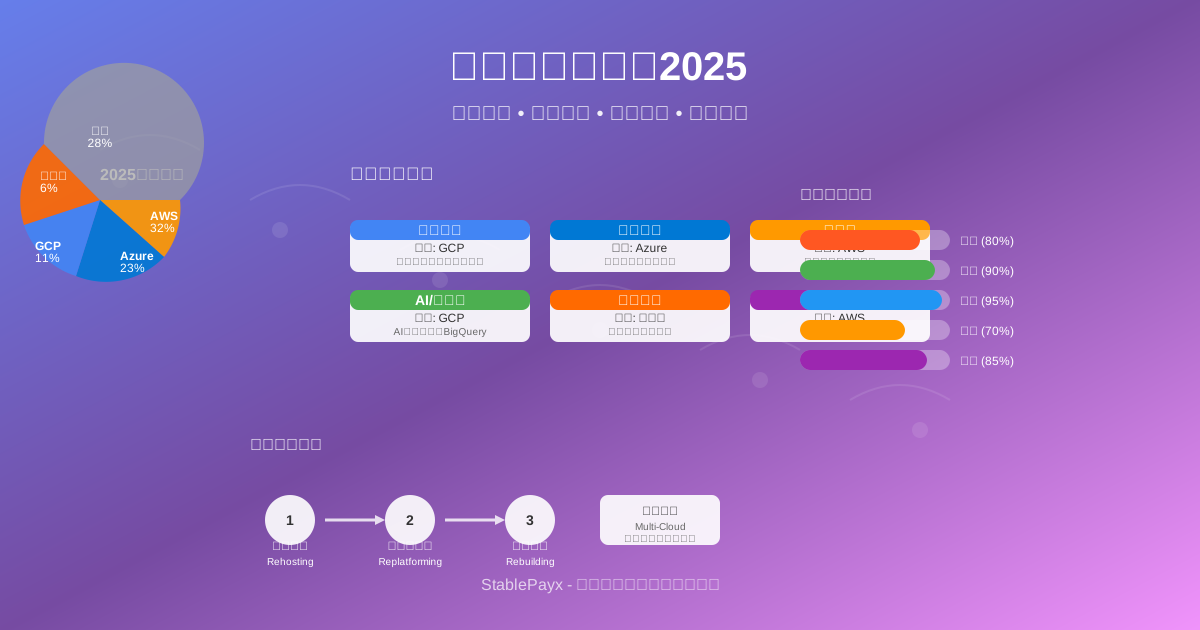
2025 Cloud Market Reality Check
Let's start with who's winning:
| Rank | Platform | Global Share | Asia-Pacific Share | Growth Rate |
|---|---|---|---|---|
| 1 | AWS | 32% | 25% | 12% |
| 2 | Azure | 23% | 18% | 18% |
| 3 | GCP | 11% | 8% | 28% |
| 4 | Alibaba Cloud | 6% | 25% | 15% |
What this means:
- AWS is still dominant, but growth is slowing
- Azure is catching up fast (18% growth vs AWS's 12%)
- GCP is the fastest growing (28%), but from a smaller base
- Alibaba Cloud owns Asia-Pacific but struggles elsewhere
Real insight: Market share doesn't mean best for you. IBM had huge market share in 1990. Didn't mean you should buy IBM.
The Decision Framework (Skip the Fluff)
Before reading cloud comparison articles (like this one), answer these questions honestly:
Business Reality Check
1. What's your actual budget?
- Under $500/month: You're too small to worry about platform choice
- $500-$5,000/month: Platform matters, but expertise matters more
- $5,000-$50,000/month: Platform choice can save you $10K+/year
- Above $50,000/month: Get quotes from all platforms and negotiate
2. Where are your users?
- 90%+ in one region: Choose platform with best coverage there
- Global but Asia-heavy: Consider Alibaba Cloud or AWS
- Global and even distribution: AWS or GCP (best global networks)
- China required: Alibaba Cloud or AWS China (separate entity)
3. What's your timeline?
- Launch in 1-3 months: Pick what your team already knows
- 6+ months timeline: You have time to learn a new platform
- Multi-year project: Platform choice really matters
Real story: A startup asked me "AWS or GCP?" I asked what their team knew. Answer: "Our CTO used to work at AWS." Decision made. They launched in 6 weeks instead of 12.
Technical Reality Check
1. What's your stack?
- .NET/Windows: Azure wins (don't even debate it)
- Java/Spring: AWS has best tooling
- Python/ML: GCP or AWS
- Node.js: AWS Lambda is most mature
- Kubernetes: GCP GKE is best
2. What's your database?
- SQL Server: Azure SQL Database (obvious choice)
- PostgreSQL/MySQL: AWS Aurora or GCP Cloud SQL
- NoSQL: AWS DynamoDB (most mature) or Azure Cosmos DB (most flexible)
- Data warehouse: GCP BigQuery (best price/performance)
3. Do you have special requirements?
- AI/ML heavy: GCP (BigQuery + Vertex AI) or Azure (OpenAI integration)
- Gaming: AWS (GameLift, best CDN)
- IoT: AWS (most mature IoT services)
- Hybrid cloud: Azure (Azure Stack is unmatched)
Platform Deep Dive: The Truth
AWS: The Safe, Expensive Choice
Best for:
- Startups that want proven technology
- Companies with complex requirements
- Teams that value mature ecosystems
- Global businesses needing maximum regional coverage
Real costs (medium web app):
- Compute: $800/month (3x m5.large instances)
- Database: $400/month (RDS MySQL)
- Storage: $200/month (S3 + EBS)
- Network: $300/month (CloudFront + data transfer)
- Total: $1,700/month
Hidden costs:
- Data transfer fees add 15-25% to bill
- Support costs extra ($29-$15,000/month depending on tier)
- Easy to over-provision (people forget to shut down dev instances)
One company's experience: E-commerce startup chose AWS. Launched successfully. Bill grew from $2,000/month to $25,000/month in 18 months. Performance was great, but they switched to GCP and cut costs to $17,000/month for same workload.
Verdict: Pick AWS if you value maturity over cost, or if your team already knows it well.
Azure: The Microsoft Integration Play
Best for:
- Companies using Office 365, Teams, Active Directory
- Traditional enterprises with Windows workloads
- Hybrid cloud scenarios (on-prem + cloud)
- .NET developers
Real costs (same medium web app):
- Compute: $760/month (3x D2s_v3 instances)
- Database: $380/month (Azure SQL)
- Storage: $190/month (Blob + Managed Disks)
- Network: $280/month (Azure CDN)
- Total: $1,610/month
- With Hybrid Benefit: $1,150/month (28% savings if you have Windows licenses)
The integration advantage: A 500-person company migrated to Azure. Single sign-on with Office 365 meant zero onboarding friction. Their IT team estimated they saved 200 hours/year on user management alone.
The integration disadvantage: Same company tried to use some AWS services alongside Azure. Managing two cloud platforms doubled their complexity. Stick to one cloud if you can.
Verdict: If you're already in Microsoft's ecosystem, Azure is a no-brainer. Otherwise, it's just another good cloud.
GCP: The Technical Excellence Play
Best for:
- Startups (generous free credits)
- Data-heavy applications
- Machine learning projects
- Cost-conscious teams
- Kubernetes-native applications
Real costs (same medium web app):
- Compute: $680/month (3x n2-standard-2, with sustained discounts)
- Database: $320/month (Cloud SQL)
- Storage: $180/month (Cloud Storage)
- Network: $260/month (Cloud CDN)
- Total: $1,440/month (15% cheaper than AWS)
Why it's cheaper:
- Automatic sustained use discounts (no commitment needed)
- Per-second billing (not rounded up to hours)
- Simpler pricing (fewer hidden fees)
- Better default instance performance
The data science advantage: A fintech company processes 50TB data daily. On AWS, they used Redshift + EMR, cost $18,000/month. Switched to GCP BigQuery, same workload, $7,500/month. That's $126,000/year savings.
The ecosystem disadvantage: Fewer third-party integrations. Some monitoring/security tools support AWS/Azure but not GCP.
Verdict: Best value for money. Pick GCP if you want to save 15-30% and your team is technical enough to handle a slightly smaller ecosystem.
Alibaba Cloud: The Asia Specialist
Best for:
- China market (required for compliance)
- Asia-Pacific businesses
- Cost-conscious projects
- E-commerce platforms
Real costs (same medium web app):
- Compute: $560/month (3x ecs.c6.large)
- Database: $280/month (RDS MySQL)
- Storage: $150/month (OSS)
- Network: $220/month (CDN)
- Total: $1,210/month (29% cheaper than AWS)
China reality: If you need to operate in China, you basically have two choices:
- Alibaba Cloud (dominant, best coverage)
- AWS China (separate entity, requires Chinese business partner)
Azure and GCP have limited China presence.
Asia-Pacific performance: For users in Southeast Asia, Alibaba Cloud has significantly lower latency than US-based clouds.
| Destination | AWS Singapore | Alibaba Singapore | Latency Difference |
|---|---|---|---|
| Jakarta | 45ms | 28ms | 38% faster |
| Manila | 52ms | 35ms | 33% faster |
| Bangkok | 38ms | 24ms | 37% faster |
The documentation problem: English documentation is inconsistent. Some services have excellent docs, others are clearly machine-translated. If your team doesn't read Chinese, expect frustration.
Verdict: Required for China. Great value for Asia-Pacific. Questionable for global businesses.
Decision Matrix: Just Tell Me What to Choose
By Business Type
Startup (5-20 people, <$5K/month cloud budget): → GCP (best free tier, cheapest costs, easy to learn)
- $300 free credit for 90 days
- Always-free tier (1 f1-micro instance, 30GB storage)
- Per-second billing saves money on dev/test
Mid-size Company (50-500 people, $5K-$50K/month): → AWS if you need maturity, GCP if you want value
- AWS: 200+ services, every use case covered
- GCP: 20-30% cheaper, excellent for data workloads
Enterprise (500+ people, $50K+/month): → Azure if you use Microsoft, AWS otherwise
- Azure: Seamless enterprise integration, hybrid cloud
- AWS: Most enterprise features, best compliance coverage
China/Asia-Pacific Focus: → Alibaba Cloud
- Only real choice for China compliance
- Best latency and pricing in Asia
By Technical Stack
.NET Applications: → Azure (not even close)
- Visual Studio integration
- Azure Functions best for C#
- Hybrid Benefit saves 30-40%
Java/Spring Applications: → AWS or Alibaba Cloud
- AWS: Best Spring Cloud support
- Alibaba: Built on Java, excellent middleware
Python/Data Science: → GCP
- BigQuery is the best data warehouse
- Vertex AI excellent for ML
- Jupyter notebooks built-in
Containerized Apps: → GCP
- GKE (Kubernetes Engine) is industry-best
- Autopilot mode manages everything
- Cloud Run excellent for simple deployments
Multi-Language/Flexible: → AWS
- Best support for everything
- Most mature serverless (Lambda)
- Largest ecosystem
By Budget Priority
Maximum Savings:
- GCP (automatic discounts, per-second billing)
- Alibaba Cloud (cheapest base prices)
- Azure (with Hybrid Benefit)
- AWS (most expensive, but most features)
Predictable Costs:
- Azure (Enterprise Agreements, clear pricing)
- GCP (sustained discounts are automatic)
- AWS (requires careful RI/Savings Plan management)
- Alibaba Cloud (subscription model is clearest)
Best Free Tier:
- GCP ($300 credit, 90 days, no auto-charge)
- Azure ($200 credit, 30 days)
- AWS (12 months free for specific services)
- Alibaba Cloud (limited trials, varies by region)
Migration Strategy: You Don't Have to Pick Forever
Here's something most guides don't tell you: You can change your mind.
Start Small, Then Grow
Phase 1: MVP (Months 1-6)
- Pick what your team knows
- Use managed services (don't over-engineer)
- Monitor costs weekly
Phase 2: Growth (Months 6-18)
- Optimize instance types
- Add reserved instances for stable workloads
- Consider switching if costs are too high
Phase 3: Scale (18+ months)
- Multi-region if needed
- Maybe multi-cloud (but only if necessary)
- Negotiate enterprise agreements
Real example: A SaaS company started on AWS (team knew it). After 12 months, they moved data warehouse to GCP BigQuery (60% cost savings). Kept compute on AWS. Hybrid approach saved $85,000/year.
When to Switch Platforms
Consider switching if:
- Your bill is $10,000+/month and you could save 20%+ elsewhere
- Your primary use case changed (started doing more ML, switched to GCP)
- You got acquired by a company using different cloud
- Compliance requirements changed
Don't switch if:
- You're just chasing a 5-10% savings (migration costs will eat that)
- Your team is happy and productive
- You're in the middle of rapid growth (stability > optimization)
Cost Optimization (Works on Any Platform)
No matter which platform you choose, do these things:
1. Right-Size Everything (Saves 30-50%)
Most companies waste 30-50% on over-provisioned instances.
How to fix:
- Install monitoring (CloudWatch, Azure Monitor, GCP Monitoring)
- Check CPU/memory utilization weekly
- Downsize instances running <40% utilization
Real case: E-commerce company had 20x m5.xlarge instances (8 vCPU, 32GB RAM). Average CPU: 18%. We moved them to m5.large (2 vCPU, 8GB RAM) and saved $38,000/year.
2. Use Reserved Instances/Commitments (Saves 40-70%)
For workloads running 24/7:
- AWS: Reserved Instances or Savings Plans
- Azure: Reserved Instances
- GCP: Committed Use Discounts
- Alibaba: Subscription pricing
Real savings:
- m5.large on-demand: $70/month
- m5.large reserved (1-year): $42/month (40% savings)
- m5.large reserved (3-year): $27/month (61% savings)
Rule: If instance runs >80% of the time, use reserved pricing.
3. Auto-Shutdown Dev/Test (Saves 60-75%)
Development environments don't need to run nights and weekends.
Schedule:
- Workdays: 9am-7pm (10 hours)
- Weekends: Off
- Total: 50 hours/week vs 168 hours/week (70% reduction)
Real savings: Company with $15,000/month dev environment bill. Auto-shutdown saved $10,500/month. That's $126,000/year.
4. Use Spot/Preemptible Instances (Saves 60-90%)
For fault-tolerant workloads (batch processing, CI/CD, dev environments):
- AWS Spot: 70-90% discount
- Azure Spot: 70-90% discount
- GCP Preemptible: 60-80% discount
- Alibaba Preemptible: 70-90% discount
Caveat: Cloud provider can terminate with 30 seconds - 2 minutes notice.
Good for: Data processing, rendering, testing, CI/CD Bad for: Databases, stateful apps, real-time services
Real case: ML training company spent $30,000/month on model training. Switched to Spot Instances, same training, $6,000/month. Saved $288,000/year.
The Multi-Cloud Trap
Every consultant will tell you "multi-cloud is the future." They're mostly wrong.
Multi-Cloud Sounds Smart
Promised benefits:
- Avoid vendor lock-in
- Use best service from each provider
- Better negotiating position
- Disaster recovery across providers
Multi-Cloud Reality
Actual costs:
- 2x complexity (two consoles, two monitoring systems, two billing systems)
- 2x expertise needed (team needs to know multiple platforms)
- Data transfer between clouds is expensive ($0.09-$0.12/GB)
- Integration is painful (different IAM, networking, security models)
Real example: A fintech company ran AWS for compute, GCP for BigQuery. Transferring 10TB/month between clouds cost $1,000/month. Managing two platforms required 3 full-time DevOps engineers instead of 2. Extra cost: $180,000/year in salaries.
When Multi-Cloud Makes Sense
Only do multi-cloud if:
- You're huge (>$1M/month cloud spend)
- You have regulatory requirements for redundancy
- You acquired a company on different cloud
- One platform has a unique service you absolutely need
For everyone else: Pick one cloud, get really good at it, negotiate better rates.
My Actual Recommendation
After 200+ cloud migrations, here's my decision tree:
Do you use Office 365, Active Directory, and Windows? → Yes: Pick Azure. Don't overthink it. → No: Continue...
Is >50% of your business in China? → Yes: Pick Alibaba Cloud. It's required. → No: Continue...
Is your monthly cloud budget under $2,000? → Yes: Pick GCP. Best free tier, cheapest costs. → No: Continue...
Are you building a data/ML-heavy application? → Yes: Pick GCP. BigQuery and Vertex AI are unmatched. → No: Continue...
Does your team already have expertise in one cloud? → Yes: Pick that cloud. Expertise > features. → No: Continue...
You've made it this far without a clear answer? → Pick AWS. It's the safe choice. You won't regret it, even if you won't get the best price.
Final Thoughts
The truth is, all four major clouds are good enough for 95% of use cases. Your choice matters less than:
- How well you optimize costs
- How skilled your team is
- How well you architect your application
I've seen companies thrive on AWS and fail on GCP. I've seen companies thrive on GCP and fail on AWS. Platform wasn't the difference - execution was.
Pick a cloud. Learn it deeply. Optimize ruthlessly. You'll be fine.
And remember: you're not married to your cloud provider. If you make the wrong choice, you can switch. It'll cost you 2-6 months of engineering time, but it's not permanent.
Choose based on your current reality, not your imagined future. You can always change later.
Need help with cloud costs regardless of platform? StablePayx lets you pay for AWS, Azure, GCP, and Alibaba Cloud with USDT/USDC stablecoins, saving 10-20% on bills. We support all major cloud providers with one unified payment solution. Contact us for multi-cloud pricing.