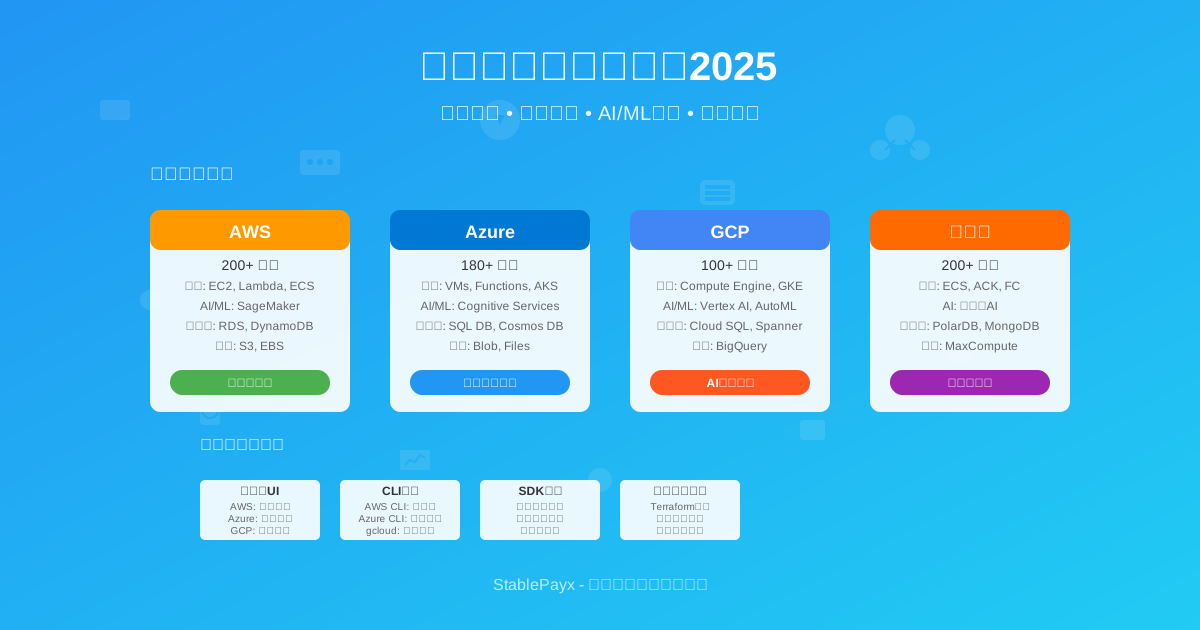
AWS vs Azure Technical Ecosystem Comparison 2026: Which Cloud Has More Comprehensive Services?
Price matters, but for technical teams, the real question is: which platform has the tools and services you actually need? After migrating dozens of applications across all four major clouds, here's what I learned about their technical ecosystems.
Service Breadth: AWS Has Everything, Azure Has Enough
AWS: The Everything Store of Cloud Services
AWS has 200+ services. That's not marketing hype - they literally have a service for everything. The problem? You'll use maybe 15 of them.
Services You'll Actually Use:
- Compute: EC2 (VMs), Lambda (serverless), ECS/EKS (containers)
- Storage: S3 (object), EBS (block), EFS (file)
- Database: RDS (relational), DynamoDB (NoSQL), Aurora (MySQL/PostgreSQL on steroids)
- Network: VPC, CloudFront (CDN), Route 53 (DNS)
- AI/ML: SageMaker (if you're serious about ML)
Services You Probably Won't:
- AWS RoboMaker (robot simulations)
- AWS Snowmobile (literal truck that moves data)
- AWS Ground Station (satellite communications)
AWS releases 50+ new services every year. Most are niche. A few become industry standards. The ecosystem is mature, battle-tested, and occasionally overwhelming.
Azure: Microsoft's Cloud, For Better or Worse
Azure has ~200 services, close to AWS in number. The difference? Azure's services are deeply integrated with Microsoft's ecosystem.
Core Services:
- Compute: Virtual Machines, Functions, AKS (Kubernetes)
- Storage: Blob, Files, Managed Disks
- Database: SQL Database, Cosmos DB (multi-model NoSQL)
- Network: Virtual Network, CDN, Application Gateway
- AI/ML: Azure ML, Cognitive Services, OpenAI Service (exclusive ChatGPT integration)
Azure's Secret Weapon: If you're running Windows, Active Directory, SQL Server, or Office 365, Azure integration is seamless. I watched a company migrate their .NET apps to Azure in 2 weeks. Same apps on AWS would've taken 6 weeks.
GCP and Alibaba Cloud: Specialized Players
Google Cloud (100+ services):
- Fewer services, but higher quality in specific areas
- BigQuery: Best data warehouse, period
- Kubernetes Engine: Where Kubernetes was born
- Vertex AI: Excellent ML platform
A data science team I worked with switched from AWS to GCP just for BigQuery. They process 50TB daily and their query costs dropped 60%.
Alibaba Cloud (200+ services):
- Service breadth matches AWS
- Strong in e-commerce, middleware, security
- Built the tech that runs Singles' Day (world's biggest shopping event)
- English documentation is hit-or-miss
Developer Experience: Azure Wins (Surprisingly)
Management Consoles Ranked
Azure Portal: 9/10
- Modern, clean interface
- Consistent experience across services
- Customizable dashboards that actually help
- Only downside: Some advanced features are buried deep
AWS Console: 7/10
- Comprehensive but cluttered
- Each service feels like a different app (because it is)
- Powerful search helps navigate chaos
- Learning curve is steep
GCP Console: 8/10
- Cleanest interface
- Excellent search
- Integrated Cloud Shell (bash terminal in browser)
- Fewer features = less overwhelming
Alibaba Cloud Console: 6/10
- Good Chinese interface
- English version lacks features
- Documentation quality varies
- Fine for basic tasks, frustrating for complex setups
CLI and SDK: AWS Has the Best Tools
| Platform | CLI Tool | Languages Supported | Docs Quality | Community |
|---|---|---|---|---|
| AWS | AWS CLI | 12+ | Excellent | Huge |
| Azure | Azure CLI | 10+ | Very Good | Large |
| GCP | gcloud | 8+ | Very Good | Medium |
| Alibaba | aliyun CLI | 7+ | Okay | Small |
Real-world experience: AWS CLI is the gold standard. Every command is well-documented, Stack Overflow has answers to everything, and third-party tools integrate seamlessly.
Azure CLI is good, but sometimes you need PowerShell for certain features. GCP's gcloud is clean and logical. Alibaba's CLI works but feels less polished.
Infrastructure as Code: Terraform Wins, Everyone Uses It
Terraform Support:
- AWS: Perfect. 500+ resource types
- Azure: Very good, occasional 2-3 week lag on new features
- GCP: Very good, generally up-to-date
- Alibaba Cloud: Basic support, some services missing
Native IaC Tools:
- AWS CloudFormation: Powerful but verbose (100 lines of YAML for simple things)
- Azure Bicep: Modern, clean syntax (Microsoft finally learned from Terraform)
- GCP Deployment Manager: Limited features, most people skip it
- Alibaba Cloud ROS: Works for basic needs
My recommendation: Use Terraform everywhere. Even if a platform's native tool is good, Terraform gives you multi-cloud flexibility.
AI and Machine Learning: Azure Has OpenAI, GCP Has Everything Else
Pre-built AI Services
AWS AI Services:
- Rekognition (image/video analysis)
- Transcribe (speech-to-text)
- Polly (text-to-speech, sounds pretty natural)
- Comprehend (NLP, sentiment analysis)
These work well out-of-the-box. A content moderation platform I consulted for processes 10M images/month on Rekognition with 99.5% accuracy.
Azure AI Services:
- Cognitive Services (vision, speech, language)
- Azure OpenAI Service (ChatGPT, GPT-4, DALL-E)
- Form Recognizer (reads invoices, receipts automatically)
- Bot Framework
Azure's exclusive access to OpenAI models is a huge differentiator. Companies are choosing Azure just to get GPT-4 API access with enterprise support.
GCP AI Services:
- Vision AI, Speech-to-Text
- Natural Language AI
- Translation AI (built on Google Translate tech)
- AutoML (train custom models with no code)
GCP's AutoML is surprisingly good. Non-ML engineers can build decent models. I saw a marketing team build a logo detection model in 3 hours.
Alibaba Cloud AI:
- Visual Intelligence Platform
- Intelligent Speech Interaction
- Natural Language Processing
- Strong in Chinese language processing
Machine Learning Platforms: It's Complicated
| Feature | AWS SageMaker | Azure ML | GCP Vertex AI |
|---|---|---|---|
| Model Training | Excellent | Very Good | Excellent |
| AutoML | Good | Excellent | Very Good |
| Model Deployment | Excellent | Good | Very Good |
| Notebook Environment | Good | Good | Very Good |
| MLOps | Good | Excellent | Very Good |
| Pricing | High | Medium | Medium |
Real comparison: I built the same ML pipeline on all three platforms:
- SageMaker: Most features, most complex, highest cost ($2,400/month)
- Azure ML: Best MLOps, good integrations, medium cost ($1,800/month)
- Vertex AI: Clean interface, great notebooks, lowest cost ($1,500/month)
For most ML teams, Vertex AI offers the best balance. For large enterprises with MLOps needs, Azure ML edges ahead.
Containers and Kubernetes: GCP Wins, Then AWS, Then Azure
Kubernetes Services Ranked
1. GCP GKE (Google Kubernetes Engine)
- Kubernetes was invented at Google
- Autopilot mode: Google manages everything, you just deploy
- Best performance, most features
- A DevOps team I worked with migrated from AWS EKS to GKE and cut their K8s management time by 60%
2. AWS EKS (Elastic Kubernetes Service)
- Mature, reliable, well-integrated with AWS services
- Fargate mode: Serverless Kubernetes (no node management)
- Good but more expensive than GKE
3. Azure AKS (Azure Kubernetes Service)
- Solid but lags behind in features
- Free control plane (nice cost savings)
- Windows container support is best-in-class
Serverless Containers:
- AWS Fargate > GCP Cloud Run > Azure Container Instances
- Fargate integrates with both ECS and EKS
- Cloud Run is simpler and cheaper for simple use cases
Databases: Each Platform Has a Winner
Relational Databases
AWS Aurora: Best PostgreSQL/MySQL Experience
- 5x faster than standard MySQL
- Auto-scaling storage (up to 128TB)
- One e-commerce company migrated from RDS MySQL to Aurora and cut database costs 40% while improving performance
Azure SQL Database: Best for SQL Server
- If you're running SQL Server, Azure SQL is the obvious choice
- Serverless tier for dev/test (pay only when database is active)
- Hybrid Benefit makes it crazy cheap if you have licenses
GCP Cloud Spanner: Best for Global Apps
- Globally distributed, strongly consistent
- Scales horizontally (rare for relational databases)
- Expensive but worth it for multi-region apps
Alibaba Cloud PolarDB:
- Good performance, competitive pricing
- Best for China-based applications
NoSQL Databases
| Use Case | AWS | Azure | GCP | Alibaba |
|---|---|---|---|---|
| Key-Value | DynamoDB | Cosmos DB | Firestore | Table Store |
| Document | DocumentDB | Cosmos DB | Firestore | MongoDB |
| Graph | Neptune | Cosmos DB | - | GDB |
| Time Series | Timestream | Time Series Insights | - | TSDB |
DynamoDB is AWS's secret weapon. Scales infinitely, single-digit millisecond latency, fully managed. Discord uses DynamoDB to handle billions of messages.
Cosmos DB is Azure's answer - multi-model (key-value, document, graph, column), multi-region replication. More flexible than DynamoDB but also more complex.
Network and CDN: AWS Has the Most, GCP Has the Fastest
CDN Edge Locations
- AWS CloudFront: 450+ PoP locations
- Azure CDN: 170+ PoP locations
- GCP Cloud CDN: 140+ PoP locations
- Alibaba Cloud CDN: 2,800+ nodes (mostly in Asia)
Real-world latency test (serving 1MB file to global users):
- AWS CloudFront: Average 45ms
- Azure CDN: Average 52ms
- GCP Cloud CDN: Average 41ms (winner)
- Alibaba Cloud CDN: 28ms in Asia, 120ms elsewhere
Verdict: GCP has the fastest global network (they own undersea fiber cables). Alibaba Cloud dominates Asia but weak elsewhere.
Network Features
AWS:
- Transit Gateway simplifies complex multi-VPC setups
- Global Accelerator (uses AWS backbone instead of public internet)
- Most regions (31) and availability zones (99)
Azure:
- ExpressRoute for private connections to Azure
- Virtual WAN for managing global networks
- Best hybrid cloud networking
GCP:
- Premium Network Tier routes traffic on Google's private fiber network (faster than public internet)
- Lowest latency between regions
- Simpler networking model (less configuration needed)
Security and Compliance: AWS Has Most Certifications, Azure Has Active Directory
Compliance Certifications
All four platforms have the major ones (ISO 27001, SOC 2, PCI DSS, GDPR). Key differences:
- AWS: Most certifications (100+), covers niche industries
- Azure: Government certifications (FedRAMP High, DoD Impact Level 5)
- GCP: Good coverage, fewer niche certifications
- Alibaba Cloud: Strong in Asia, weaker in US/Europe compliance
Native Security Tools
AWS:
- GuardDuty: Threat detection ($4/month for typical setup)
- Security Hub: Centralized security dashboard
- IAM: Complex but powerful access control
Azure:
- Security Center: Good free tier
- Sentinel: SIEM (security event monitoring)
- Azure AD: Best enterprise identity management
GCP:
- Security Command Center: Free tier available
- Chronicle: Security analytics
- Simpler IAM (easier to understand than AWS)
Real experience: Azure AD integration makes enterprise security much easier. One company reduced their onboarding time from 2 days to 2 hours using Azure AD + conditional access policies.
Support and Training: AWS Has the Most Resources
Technical Support Response Times
All four platforms offer 4 support tiers. Here's what you actually get:
- AWS Enterprise: 15-minute response for critical issues, dedicated Technical Account Manager
- Azure Unified: 1-hour response, similar to AWS Enterprise
- GCP Enterprise: 1-hour response, improving but smaller team
- Alibaba Cloud: Best Chinese support, limited English support
Reality check: Unless you're paying $15,000+/month for enterprise support, you'll mostly rely on documentation and Stack Overflow.
Certification and Training
AWS Certifications:
- 12 certifications
- Most recognized by employers
- Solutions Architect Associate is industry standard
Azure Certifications:
- 10+ certifications
- Integrated with Microsoft Learn (free training)
- Good for enterprise career paths
GCP Certifications:
- 7 certifications
- Less recognized, but respected in tech companies
- Professional Cloud Architect is excellent
My recommendation: Get AWS Solutions Architect Associate first (most valuable). Then specialize based on your platform.
Platform Strengths and Weaknesses
AWS: The Safe Choice
Strengths:
- Most mature services (everything just works)
- Best documentation and community
- Largest ecosystem of third-party tools
- If you can imagine it, AWS probably has a service for it
Weaknesses:
- Overwhelming number of options
- Console UI is inconsistent
- Costs can spiral quickly without monitoring
- Complexity tax: simple things require multiple services
Best for: Startups that want proven technology, enterprises with complex needs
Azure: The Microsoft Integration Play
Strengths:
- Seamless Microsoft ecosystem integration
- Best hybrid cloud (Azure Stack, Arc)
- Azure AD is unmatched for enterprise identity
- Excellent for .NET and Windows workloads
Weaknesses:
- Some services less mature than AWS equivalents
- Smaller Asia-Pacific presence
- Less community content (fewer blog posts, tutorials)
- Support quality can be inconsistent
Best for: Enterprises using Microsoft products, .NET shops, hybrid cloud scenarios
GCP: The Technical Excellence Play
Strengths:
- Best network performance (owns the fiber)
- Leading in big data (BigQuery) and ML (Vertex AI)
- Cleanest, most logical interface
- Kubernetes-native, open-source friendly
Weaknesses:
- Fewer services overall
- Smaller ecosystem (fewer third-party integrations)
- Less enterprise-focused (improving but still behind)
- Smaller market share means fewer experts available
Best for: Startups, data-heavy workloads, ML/AI projects, Kubernetes users
Alibaba Cloud: The Asia Play
Strengths:
- Dominant in China market
- 20-30% cheaper than AWS/Azure
- Excellent for e-commerce (powers Alibaba's platforms)
- Best Chinese language support
Weaknesses:
- English documentation is inconsistent
- Limited global presence outside Asia
- Smaller community and fewer resources
- Some services lag behind AWS/Azure
Best for: China market, Asia-Pacific businesses, cost-conscious projects
Technical Stack Recommendations
Java/Spring Applications
Ranking: AWS > Azure > GCP > Alibaba Cloud
AWS has the most mature Java tooling. Spring Cloud AWS integration is excellent. One large Spring Boot application migrated to AWS and deployment went from 45 minutes to 8 minutes using ECS.
.NET/C# Applications
Ranking: Azure > AWS > GCP > Alibaba Cloud
This isn't even close. Azure's .NET integration is seamless. Visual Studio deploys directly to Azure. Azure Functions work better with C# than AWS Lambda does.
Python/Data Science
Ranking: GCP > AWS > Azure > Alibaba Cloud
BigQuery + Vertex AI + Cloud Run is an incredible combo for data science. GCP's Python SDK is clean and well-designed. One ML team cut their model training costs by 50% switching from AWS to GCP.
Node.js/JavaScript
Ranking: AWS > GCP > Azure > Alibaba Cloud
AWS Lambda has the best Node.js support. Cold starts are faster, debugging is better. Vercel and Netlify run on AWS for a reason.
Containerized/Kubernetes Apps
Ranking: GCP > AWS > Azure > Alibaba Cloud
GKE (Google Kubernetes Engine) is the best Kubernetes service, period. If your app is already containerized, GCP is the natural choice.
Final Recommendation
Choose your platform based on what you're building:
- Standard web app: AWS (most resources, proven tech)
- .NET enterprise app: Azure (seamless integration)
- Data-heavy application: GCP (BigQuery, Vertex AI)
- China market: Alibaba Cloud (compliance, latency)
- ML/AI project: GCP or Azure (depending on whether you need OpenAI)
- Hybrid cloud: Azure (Azure Stack, Arc)
The truth: All four platforms are good enough for most projects. Your team's expertise and existing tech stack matter more than platform differences. Pick one, learn it deeply, and optimize costs. You'll be fine.
Multi-cloud sounds smart but adds complexity. Most companies are better off picking one cloud and becoming really good at it.
Need help managing cloud costs across platforms? StablePayx lets you pay for AWS, Azure, GCP, and Alibaba Cloud with USDT/USDC, saving 10-20% on bills. Contact us to learn more.