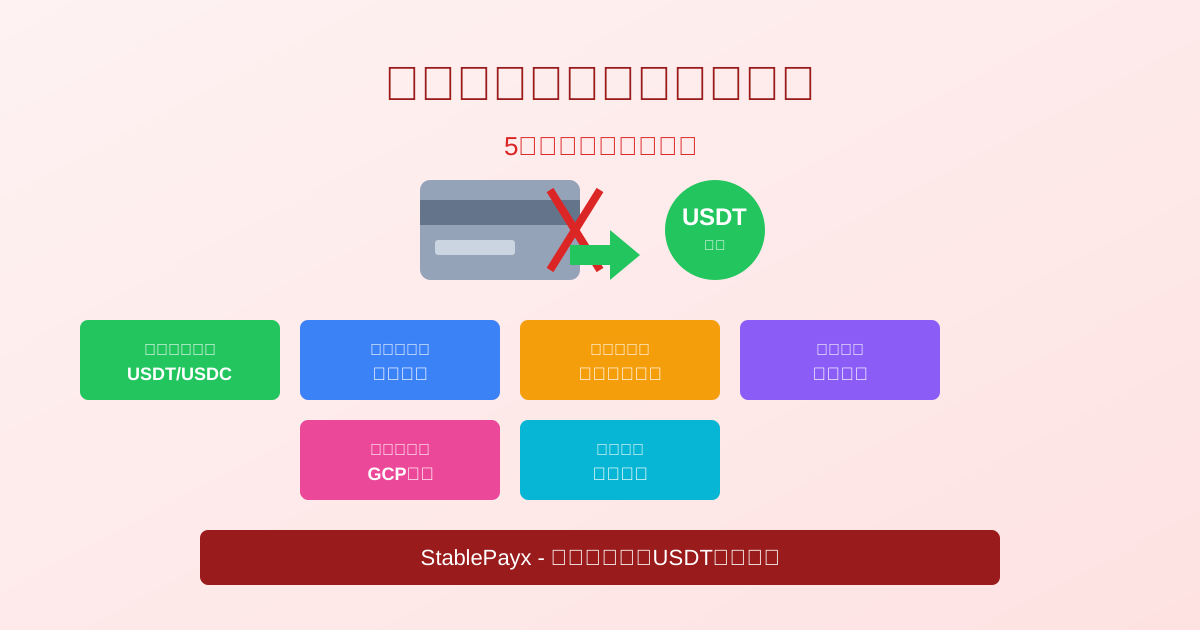
How to Buy Cloud Services Without a Credit Card: Complete 2026 Guide
You Don't Need a Credit Card
Let me guess: you want to spin up an AWS instance, but you don't have a credit card. Maybe you're a student. Maybe you're from a country where credit cards aren't common. Maybe you just don't want one.
The internet will tell you "just get a credit card." That's useless advice. Here's what actually works.
Why This Happens
Cloud providers love credit cards because:
- They can charge you automatically when bills come due
- No upfront payment processing on their end
- Easy to verify you're a real person (that $1 authorization)
- Lower fraud risk than prepaid methods
But credit cards aren't universal. In many countries, debit cards are the norm. Students can't get credit cards easily. Freelancers might not qualify. This locks out millions of potential cloud users.
Option 1: Just Use a Debit Card
This works more often than you think.
AWS, Google Cloud, Azure, Alibaba Cloud - they all accept debit cards. The card just needs:
- A Visa or MasterCard logo
- International payments enabled
- Enough balance for the $1 verification charge
I've used debit cards from 10+ countries on AWS. The failure rate is maybe 20%, and it's usually because international payments were disabled by default.
Call your bank first Tell them: "I'm going to charge $5-10 to Amazon Web Services in the US" (or wherever your region is). This prevents the fraud detection system from blocking it.
Keep buffer balance AWS bills 3-5 days after usage. If you spend $50 on the 15th, the charge hits your card on the 18th-20th. With a credit card, who cares? With a debit card, you need that $50 actually available.
Real example: My friend in India couldn't get a credit card. Her HDFC debit card worked perfectly on AWS after enabling international transactions. Total setup time: one phone call to the bank.
Option 2: Virtual Credit Cards
These are prepaid cards that exist only digitally.
You load them with money, then use them like a regular credit card. For cloud services, they work great because:
- No credit check required
- Create multiple cards for different projects
- Set spending limits to control costs
- Protect your main bank account
Platforms that work well:
Wise (formerly TransferWise) Best for: International users who want real exchange rates
- Create virtual cards in USD, EUR, GBP
- Fund via bank transfer
- Low fees (under 1%)
- Works on all major clouds
I use Wise personally. Loaded $500, created a virtual card, added it to AWS. Worked first try.
Revolut Best for: Europeans and UK users
- Free virtual cards
- Instant card creation
- Good exchange rates
- Disposable cards for one-time use
Privacy.com (US only) Best for: Americans who want privacy
- Create unlimited virtual cards
- Free for personal use
- Set spending limits per card
- Close cards instantly if compromised
Crypto-funded virtual cards Platforms like Crypto.com or Binance offer cards you can load with USDT/BTC. You're essentially converting crypto to a virtual card balance, then using that to pay clouds.
The fees are higher (2-3%), but if your money is already in crypto, it's the path of least resistance.
How to set this up:
- Pick a platform available in your country
- Register and complete verification (usually needs ID)
- Fund your account via bank transfer or crypto
- Create a virtual card
- Add it to your cloud provider's payment settings
Time investment: 1-2 hours the first time. Then it's instant for future cards.
Option 3: Cryptocurrency Payment
The elephant in the room: you can pay cloud bills with crypto.
Not directly - no major cloud accepts BTC or USDT at checkout. But platforms like StablePayx act as intermediaries:
- You send them USDT/USDC/BTC
- They credit your AWS/GCP/Azure account using their corporate cards
- You get a receipt for your records
Why this works:
I know a developer in Pakistan. Banks there make international payments nearly impossible. Credit cards have 25% import duties. He has $15K in USDT from freelancing. For him, crypto payment isn't a novelty - it's the ONLY option that works.
Specific example with StablePayx:
- Want to add $1000 to AWS
- Send 900 USDT (they give 10% discount)
- Wait 10-30 minutes for processing
- AWS account credited
Total cost: $900 in USDT + $1-5 network fee = $905 effective cost. You saved $95 compared to face value.
The trust factor: You're trusting a third party. This isn't ideal. But:
- Start with small amounts ($100)
- Check their reputation (Telegram reviews, etc.)
- Keep transaction records
- Scale up once you verify they're legit
Option 4: PayPal (Limited but Useful)
Alibaba Cloud and Tencent Cloud accept PayPal.
AWS and GCP don't. Azure technically can through specific reseller arrangements, but it's complicated.
If your use case fits Alibaba/Tencent Cloud, this is the easiest path:
- Link PayPal to your bank account or debit card
- No credit card needed
- Pay cloud bills from PayPal balance
PayPal charges 3-4% fees for international transactions. That's expensive, but it works when other options fail.
Option 5: Resellers and Proxy Services
This is how enterprises without international banking solve the problem.
You find a local reseller who:
- Has corporate accounts with cloud providers
- Accepts payment methods available in your country
- Credits your cloud account
- Issues local invoices for your accounting
In China, this is standard practice. In India, Middle East, Africa - increasingly common.
How to find reputable resellers:
- Check the cloud provider's official partner directory
- Look for companies with physical addresses and registration
- Start with small transactions
- Verify they're not just running a card farm (that'll get your account banned)
What Actually Works: Decision Tree
You have a debit card with Visa/MasterCard logo: → Try it first. Enable international payments. 80% chance it just works.
You're a student or young adult: → Virtual card services like Revolut or Wise. Easy approval.
You hold cryptocurrency: → Crypto payment services. Fastest path from USDT to AWS credits.
You're in a country with restricted banking: → Combination approach: virtual card funded by crypto, or local reseller.
You have PayPal and can use Chinese clouds: → Alibaba/Tencent with PayPal payment.
Real Success Stories
Case 1: Student in Brazil Carlos, 22, learning web development. No credit card, bank account with debit card only.
Solution: Called bank, enabled international payments on debit card. Signed up for AWS Free Tier. Set billing alert at $5 to avoid surprises.
Result: Running 3 projects on AWS for 8 months, never exceeded free tier limits.
Case 2: Startup in Indonesia Company building a SaaS product. Indonesian rupiah, no corporate credit card that works internationally.
Solution: Used StablePayx to load AWS credits with USDT (they had some from an earlier crypto investment). Monthly recurring top-ups.
Result: Saved 15% on AWS bills (10% discount + avoiding currency conversion fees). Now spending $2000/month this way.
Case 3: Freelancer in Ukraine Developer with clients worldwide. Banks disrupted by war, couldn't get reliable international payment methods.
Solution: Created Wise account, funded with earnings from clients, created virtual cards for AWS and GCP.
Result: Maintains cloud infrastructure for 5 client projects without interruption.
The Fees Reality Check
Let's compare effective costs for a $100 AWS credit:
Credit card (if you had one): $100
- Straightforward
Debit card: $100
- Same as credit, assuming international payments enabled
Wise virtual card: $100-102
- Small funding fee depending on method
Crypto payment (StablePayx): $90-95
- 10% discount, minus network fees
PayPal (on Alibaba): $103-105
- PayPal international transaction fees
Local reseller: $105-115
- Markup for their service
The crypto option is actually cheapest if you already have USDT/USDC. If you need to buy it first, add 1-3% for exchange fees.
Common Screw-Ups to Avoid
Not enabling international payments Call your bank. This takes 5 minutes. It will save you hours of frustration.
Using prepaid gift cards Some people try loading Visa gift cards. These fail 90% of the time because cloud providers verify the billing address, and gift cards often can't be verified.
Confusing networks on crypto payments Sending ERC-20 USDT to a TRC-20 address = your money is gone. Triple-check the network type.
Not setting billing alerts Debit card gets charged, you don't have balance, payment fails, AWS suspends your account. Set alerts at 50%, 80%, 100% of your expected spend.
Trusting sketchy resellers If they ask you to pay in gift cards or wire to a personal account, run away. Legit resellers have company registration you can verify.
My Recommendation
Start simple: Try your debit card. Seriously. It works more often than forums suggest.
If that fails: Get a Wise virtual card (works in 150+ countries). Costs $10, takes 2 days to set up, solves the problem permanently.
If you have crypto: Use a payment service like StablePayx. The discounts are real, and if your assets are already in USDT, it's faster than converting to fiat.
If you're a business: Find a local reseller or set up a Wise Business account. Don't try to hack around it with personal payment methods.
The Bottom Line
Not having a credit card is annoying, not insurmountable. The cloud providers don't care HOW you pay, as long as the money shows up.
Debit cards work. Virtual cards work. Crypto conversion works. PayPal works on some platforms. There's always a path forward - you just need to find the one that fits your situation.
Don't let payment methods keep you from building your project.
Stuck on cloud payments? We've helped 200+ users in restricted regions. Telegram: @awscloud51